Oklahoma City Roofing Services

Tornado Damage Repair in Oklahoma City, OK

Tornado damage repair in Oklahoma City - post-storm safety, debris-opened roofs covered and documented, and permanent rebuilds scoped from the damage map.

Wind is the second force, and it never fully leaves. Plains wind works at shingles, ridge caps, flashing and edges day after day, and storm outflows arrive with gusts that find every lifted tab and tired seal. Beyond that stands the tornado risk itself - the 1999 and 2013 paths through the southern metro are permanent local memory - and a roof's fastening, invisible from the street, is its real rating against all of it.

The housing stock matches the weather: asphalt shingles on most of the metro, from the historic districts near downtown to the newest suburbs, metal on acreage and outbuildings, low-slope and flat systems on mid-century homes and the commercial corridors. Each fails in its own Oklahoma way - hail for the shingles, fasteners for the metal, drainage for the flat roofs - and the pages here are organized around exactly that.

Signs You Need Tornado Damage Repair

Roof sections lifted or missing after the storm

Violent gusts peel sections at their fastening first - bare deck or underlayment showing means the next rain enters directly.

Debris driven into or through the roof

Boards, branches and storm debris embedded in slopes are penetrations with the evidence still in them - photograph before removal.

A roof that shifted, racked or lost its line

A ridge line that no longer runs straight, or walls out of plumb, is structural - that house gets an engineer's read, not just a roofer's.

Shingles stripped in swaths while neighbors look untouched

Tornado wind is violently local: one street stripped, the next intact. Swath patterns argue for the map, not for assumptions.

Water entering at many points at once

Multiple new leaks after one storm usually mean lifted seals and driven debris across the whole system, not one failed detail.

Gutter, vent and rooftop equipment damage

Bent, torn or missing rooftop hardware records the wind's strength and direction - and each piece is an opening until it is made right.

Why Tornado Damage Repair Is a Standing Job in Oklahoma City

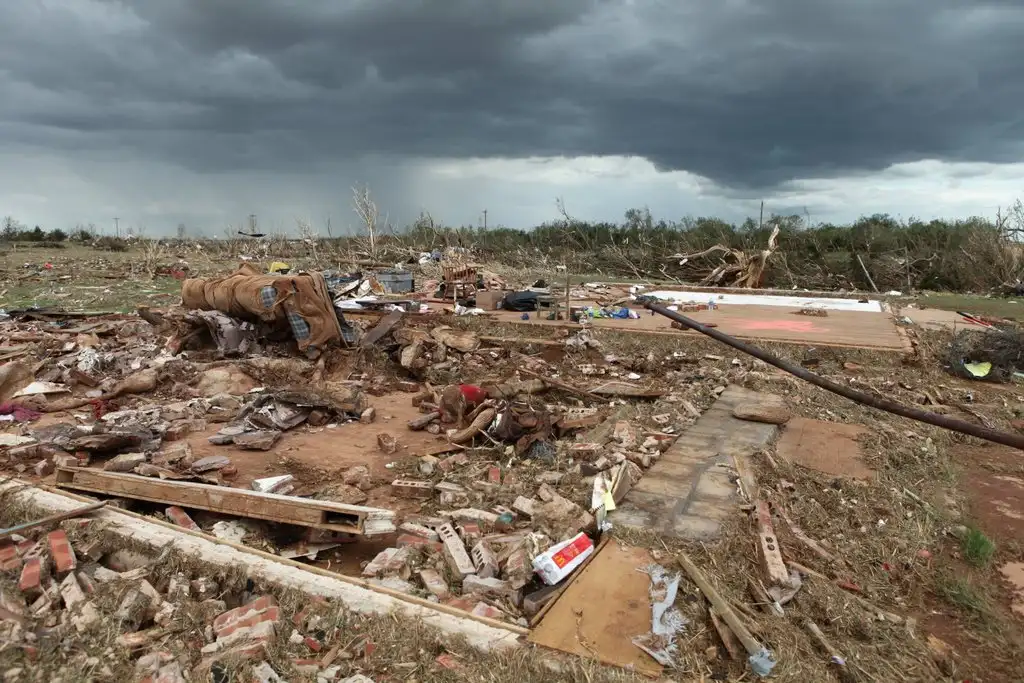
The metro's tornado history is written into its building memory: the May 3, 1999 outbreak that crossed the southern suburbs at F5 strength, the May 20, 2013 EF5 through Moore, and the widest tornado ever recorded near El Reno days later. Most addresses here will never take a direct hit - but near-path wind and debris damage is a recurring metro experience, and it is what this service is built for.

Wind near a tornado does not behave like ordinary storm wind. Gusts arrive from shifting directions, pressure changes work at every seal, and debris becomes the second storm. Roofs fail in combinations - lifted here, punctured there, seals broken everywhere - which is why the scope is drawn from a full-system map rather than from the worst-looking hole.

The rain that follows does the quiet damage. Tornadoes arrive inside storm systems, and a roof opened at 4 p.m. can take water for days. The covering window - the first dry hours - decides whether the job stays a roof job or becomes a ceilings, insulation and contents job too.

Tornado Damage Repair Through the Oklahoma City Year

Oklahoma City winters swing: bright mild weeks, then an ice storm or a hard cold snap. The December 2007 and October 2020 ice storms loaded trees and roofs across the metro in a single night each. Water that works into a crack or under a lifted shingle by day can freeze and widen it by night, and ice dams form at the eaves of poorly insulated homes. Winter is inspection and planning season here - the roofs read in winter get fixed in spring, ahead of the storms.

Spring is storm season in Oklahoma City, and it is roof season too. From March into June, peaking in May, supercell thunderstorms roll off the plains with hail, driving rain, damaging wind and the tornado risk the month is known for. The roofs that get inspected before the season are the ones that come through it quietly - a spring inspection of fasteners, sealant, edges and drainage is the single most valuable appointment on the Oklahoma City roof calendar.

Fall is the repair window. The severe season is past, the weather turns calm and cooler, and there is time to fix what the storms found, replace what the hail retired, and get a roof ready for winter. It is also when honest assessments happen, because a dry, cool roof shows its true condition to an inspector.

Tornado Damage Repair in Depth

Tornado damage has a geography that ordinary storm damage does not. The visible path is only the center of the story: violent, shifting gusts and debris rain extend well beyond it, and roofs blocks away carry lifted sections, broken seals and embedded debris while looking, from the street, like survivors. The scope that starts from the path map instead of the roof map will miss most of what the storm actually did.

It also has a sequence discipline the metro has learned the hard way. Photograph before touching, because debris in place is evidence; cover before scoping, because the rain inside the same storm system does the quiet damage; and scope in honest fractions, because a storm that opened a third of a roof did not damage the rest of it, and age had already spent some of what the wind finished. Rebuilds drawn that way settle cleanly and leave roofs actually fixed.

Choosing the Right Help

Choose tornado help on sequence and restraint: the crew that photographs before touching, covers before scoping, and separates storm damage from prior wear in writing. In the weeks after a major storm, that restraint is the whole difference between a rebuild that settles cleanly and one argued about for a year.

The Climate Behind It

Oklahoma City sits in the heart of the southern plains, where the Canadian River - renamed the Oklahoma River through the city - crosses Tornado Alley itself. The roof calendar here is written by spring supercells with large hail and damaging wind, by summers hot enough to soften shingle asphalt for weeks at a stretch, and by winters that swing from mild days to ice storms. An Oklahoma City roof is not tested by one climate - it is tested by all of them, in turns, every year.

Hail is the signature threat. Central Oklahoma sits in the part of the country where hailstones reach golf-ball size and larger with some regularity - the May 2010 hailstorm alone worked over roofs across the whole metro in a single afternoon. Bruised, cracked and granule-stripped shingles may not leak the week after a storm; they fail across the following seasons, which is why hail here is an inspection question before it is a repair question.

How Tornado Damage Repair Works

Safety and structural triage first

Downed lines, gas, unstable trees and any racked structure are assessed before roof work; unsafe houses get specialists first.

Document the damage in place

Dated photographs of every slope, the debris where it lies, and the interior water - the file the claim and the rebuild both stand on.

Cover and dry in

Debris removed carefully after documentation, openings covered with strapped tarps or temporary dry-in, the house made weather-tight.

Map, scope and rebuild

A full-system inspection maps wind, debris and water damage slope by slope; the rebuild follows the map - repairs where the system is sound, replacement where it is not.

Doing It Yourself vs a Professional

The DIY Route

  • Climbing a debris-covered, storm-weakened roof risks the collapse the storm started
  • Pulling embedded debris out before photographs erases the evidence the whole claim stands on
  • Patching the obvious hole while the seals across the system stand broken invites the next rain in everywhere
VS

The Professional Route

  • Works the order: safety, documentation, covering, then the map and the rebuild
  • Reads the whole system - wind lift, debris punctures, seal failure - not just the worst opening
  • Scopes in fractions honestly: what the storm did, what age had already done, said plainly

Keep It From Coming Back

Tornado outcomes are decided partly by preparation done in calm seasons. The habits below make a home safer to shelter in, faster to document, and simpler to put right when the worst of the metro's weather has done its work.

  • Keep a dated spring photo file of your roof - the before pictures every tornado claim wants.
  • Have dead or leaning trees over the roof removed in calm seasons, not after they land.
  • Know your safe room and your roofer's number in the same phone note.
  • Keep gutters and roof edges maintained; lifted edges are where violent wind gets its first grip.
  • Store roof paperwork and insurance details where a storm cannot take both copies.
  • After any tornado in the metro, walk your roof from the ground even if the path missed you - debris travels.
Tornado Damage Repair in the Surrounding Communities

The communities around Oklahoma City share its hail tracks and its tornado paths - with their own twists of storm history, acreage and open-country wind.

Tornado Damage Repair in Edmond

Edmond is Oklahoma City's northern anchor suburb, a fast-growing city around the University of Central Oklahoma and Arcadia Lake. Historic downtown blocks, established neighborhoods like Oak Tree, and wave after wave of new subdivisions define it.

Tornado Damage Repair in Moore

Moore is the Cleveland County city between Oklahoma City and Norman whose name is known worldwide for two storms: the May 3, 1999 tornado and the May 20, 2013 EF5 that crossed its neighborhoods. The city rebuilt both times with determination, and its subdivisions - old and rebuilt - stand along those documented paths.

Tornado Damage Repair in Norman

Norman is the Cleveland County seat and home of the University of Oklahoma, the National Weather Center and the National Severe Storms Laboratory - the science of the very storms that cross it. Campus Corner, historic neighborhoods and Lake Thunderbird at its edge round out the city.

Tornado Damage Repair in Yukon

Yukon is Canadian County's Czech capital, famous for its Czech Festival, its milling heritage and a Route 66 Main Street, and known as singer Garth Brooks's hometown. Older neighborhoods anchor the center while subdivisions spread toward Mustang and the lake.

Where Tornado Damage Repair Is Needed Most

In the historic core and the inner districts - Downtown Oklahoma City, Bricktown, Midtown, Heritage Hills, Mesta Park and Paseo Arts District, Uptown 23rd, Plaza District, Crown Heights, Nichols Hills - the housing runs from Oklahoma City's oldest homes to its grandest, and tornado damage repair follows the storm record: hail-read shingles on the older streets, steep complex roofs on the historic homes, and wind exposure that grows toward the open edges.

Across the north and south sides and the inner suburbs - The Village, Quail Creek, Belle Isle, Stockyards City, Capitol Hill, Northeast Oklahoma City and Southwest Oklahoma City, Northwest Oklahoma City, South Oklahoma City, Warr Acres, Deer Creek, Asian District - sit the subdivision waves of the postwar decades onward, the growth-edge neighborhoods and some of the metro's busiest hail tracks, which together make this the steadiest tornado damage repair territory in the city.

Beyond the city line, the same work runs in Edmond, Moore, Norman, Yukon, Mustang, Midwest City, Del City, Bethany, El Reno, Piedmont, Newcastle, Guthrie - university and air-base towns, fast-growing suburbs and the old territorial capital, where acreage, metal roofs and open-country exposure add their own chapters. Every one of these area pages carries the local detail for tornado damage repair in that community.

Coverage, In Full

Tornado Damage Repair runs across the whole service map: Downtown, Bricktown and Midtown; Heritage Hills, Mesta Park and the Paseo; Uptown 23rd, the Plaza District, Crown Heights and Nichols Hills; The Village, Quail Creek, Belle Isle and the Asian District; Stockyards City, Capitol Hill and Warr Acres; the northeast, northwest, southwest and south sides; Deer Creek; and beyond the city in Edmond, Moore, Norman, Yukon, Mustang, Midwest City, Del City, Bethany, El Reno, Piedmont, Newcastle and Guthrie. One call covers all of it - the local pages above carry the detail for each. If your street is not named here, call anyway: routes grow with demand, and most Oklahoma County addresses are already within reach of a scheduled run.

From the Oklahoma City Roofing Guides

Getting Your Oklahoma City Roof Ready for Tornado Season

Storm season does not damage sound roofs - it finds the damage the calm months already did, and delivers hail, violent wind and driven rain to every weak point at once. Prepare in early spring: test the seals, refasten what lifts, renew split sealant, clear every water path, and take the limbs over the roof down while the weather is calm.

Read the Guide

After the Storm: Documenting Roof Damage in Oklahoma County

Storm evidence fades on a schedule of weeks: granules wash, creases settle, debris gets hauled - and undocumented damage becomes undecidable damage. Photograph first (wide, then close, with scale), keep date metadata intact, label by slope, and let nothing be repaired ahead of the inspection except safety and covering.

Read the Guide

How Long Does a Roof Last in Oklahoma?

The same roof lasts years less in Oklahoma than in a calm climate - hail seasons, plains wind and summer heat spend a roof's life faster than rain ever will. Know each part's realistic range, grade the parts separately at inspection, and plan renewals (seals, fasteners, coatings) as the mid-life events they are.

Read the Guide

Tornado Damage Repair Questions

What is the difference between tornado damage and storm damage on a roof?

Tornado damage adds debris penetration, violent multi-direction gusts and seal failure across whole systems to the ordinary hail-and-wind picture. The repair discipline differs accordingly: structural triage, debris evidence and a full-system map come first.

Can a roof survive a nearby tornado with no visible damage and still be hurt?

Yes. Seals broken by pressure and gusts look like nothing from the ground and admit driven rain for seasons afterward. A lift test and seal check after a near-path event is the read that finds it while it is still cheap.

How long does tornado damage repair take in Oklahoma City?

Covering is same-day work when crews can reach the street. The rebuild follows the map and the material: measured in days for repairs, in weeks where replacement and structural work are involved. Storm scale across the metro is the honest variable.

What affects the cost of tornado damage repair in Oklahoma City?

How much of the system the storm opened, debris and tree involvement, deck and structural findings, and whether the scope is repairs, slope work or a full rebuild. The map comes first; any number before it is speculation.

My Oklahoma City home was near the path, not in it. Can it still be damaged?

Yes - near-path damage is the most common kind in the metro. Shifting violent gusts lift sections and break seals blocks from the visible path, and debris rains well beyond it. A ground walk plus an inspection settles what your roof actually took.

What should I do first after a tornado damages my Oklahoma City roof?

Safety first - stay clear of downed lines and unstable trees, keep people out from under sagging ceilings, and photograph everything before anything is moved. Then call for covering: the dry-in window is measured in hours, and every later conversation stands on the photos from day one.

Does tornado damage in Oklahoma City always mean a new roof?

No. Tornado damage is mapped in fractions: a punctured slope here, lifted sections there, sound roof elsewhere. Local damage on a sound system is repaired or re-sloped; damage across the whole system, or on a roof age had already spent, becomes replacement. The map decides, not the headline.

How is tornado damage in Oklahoma City documented for a claim?

With dated photographs before anything is touched, debris left in place until photographed, per-slope findings from the follow-up inspection, and a written separation of storm damage from prior wear. That file is what the claim is argued from, months later, when the yard is clean.

Please note: Oklahoma City Roofing Pros is an independent directory and referral service, not a roofing contractor. The professionals reachable through this site are independent businesses; any agreement for work is between you and the professional you engage. Service information on this site is general educational material - the scope of any real roofing work is set by an on-site inspection.

Hail Marks on the Roof, Shingles in the Yard or a Leak Over the Living Room?

One call connects you with a roofing professional serving Oklahoma City and the surrounding communities - inspection, repair, replacement and upkeep.

📞 Call Now
📞 Call Now